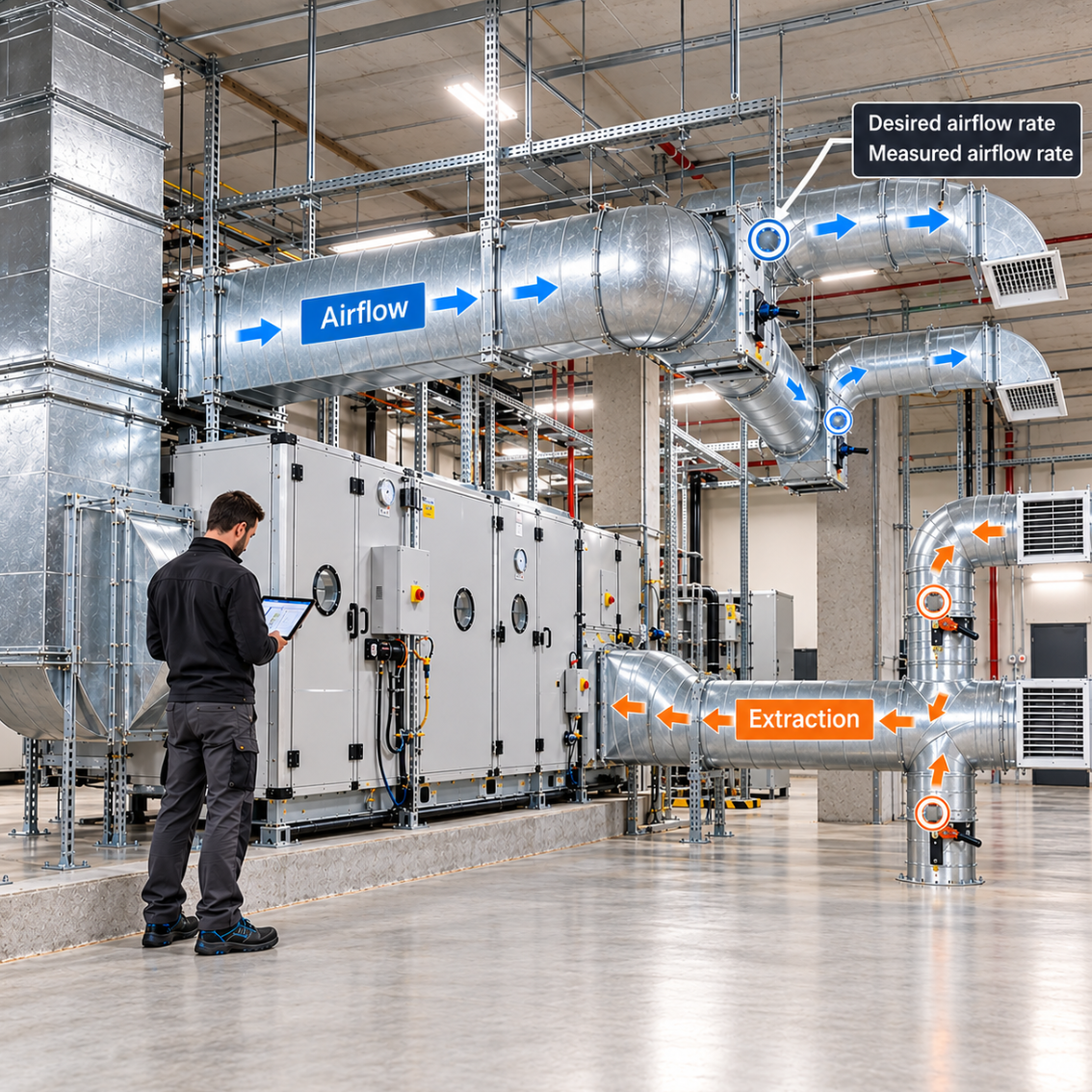
Measurement at vents, network balancing, duct measurements…
A ventilation system is not put into service based on theoretical values: its flow rates are measured, compared to the values defined during the design phase, and adjusted on site to comply with the project's specifications. A poorly balanced network can lead to discomfort, noise, overconsumption, and handover difficulties.
Between measurements at the vents, checks in the ducts, and balancing the network, each step requires the right method and the right instrument. Balometers, anemometers, manometers, Pitot tubes, DÉBIMO blades: KIMO Instruments solutions support commissioning technicians, installers, and maintenance personnel for the HVAC commissioning and tuning of an installation, right up to its handover.
Parameters to monitor
-
Airflow
-
Air velocity
-
Differential pressure
Preparing for inspections and choosing the reference standards
Preparing for inspections and choosing the reference standards
Everything starts with preparation: identifying target flow rates, branches, and balancing dampers, checking filters and dampers, and stabilizing the AHU (Air Handling Unit). The measurements to be carried out are based on standards: NF EN 12599 for handover, NF EN 16211 for on-site airflows. NF ISO 3966 completes the set for Pitot tube exploration in closed conduits.
Also specify whether the flow rates are expressed in actual or reference conditions (Nm3/h): only values recorded under the same operating conditions and according to the same standard can be compared. The measurement methods applied will depend on the configuration of the installation.

AMI 310
Kimo’s AMI 310 measures simultaneous parameters including pressure, temperature (Pt100 and thermocouple), humidity, air quality (CO/CO2), air velocity, airflow (vane probes and hotwire), and tachometry.

DBM 620
The newly redesigned Kimo DBM 620 Air Flow Meter is a multipurpose electronic air balancing instrument primarily used for efficiently taking direct air volume readings from air vents.

MP 210
Kimo’s MP 210 micromanometer measures pressure, air velocity, airflow, temperature, tachometry, gas leak and carbon monoxide (up to 6 simultaneous measurements).

Measuring airflow at the vents
Measuring airflow at the vents
The first control point: vents, diffusers, and grilles. The DBM620 balometer provides a direct reading of the airflow thanks to its hood, which must completely cover the terminal. With a suitably sized hood and an airtight seal, it allows for quick and effective comparison of supply and exhaust air.
With 5 hood sizes and a patented frame, the DBM620 also measures temperature, relative humidity, atmospheric pressure, and calculates the air change rate. Its ultra-compact design makes it easy to transport within technical areas, and the Pilot application completes the package. If necessary, it can also be used with Pitot tubes or a measurement grid specifically designed for supply ceilings.
DBM 620
The newly redesigned Kimo DBM 620 Air Flow Meter is a multipurpose electronic air balancing instrument primarily used for efficiently taking direct air volume readings from air vents.
AMI 310
Kimo’s AMI 310 measures simultaneous parameters including pressure, temperature (Pt100 and thermocouple), humidity, air quality (CO/CO2), air velocity, airflow (vane probes and hotwire), and tachometry.

Airflow cones
The Si-K25 and Si-K85 are airflow measurement cones designed for 100 mm diameter vane anemometers. These models feature a honeycomb-structured airflow straightener that reduces turbulence for more reliable flow measurement.
The Si-K25 and Si-K85 are perfectly suited to Kimo LV 110 and LV 130, VT 210, MP 210 and AMI 310 anemometers.
The Si-K85 square cone can be used with medium-sized air vents.
The Si-K25 round cone is designed for small and medium-sized round vents.
|
|
|
|
Designation |
Si-K25 (28111) |
Si-K85 (28112) |
Flow |
10 to 400 m3/h |
10 to 400 m3/h |
Internal dimensions |
Ø 260 mm |
350 x 350 mm |
External dimensions |
L 282 x W 282 x H 268 mm |
L 372 x W 372 x H 327 mm |


Checking flow rates in ducts
Checking flow rates in ducts
In ducts, the method depends on the flow profile. With the AMI310, MP210, or VT210 equipped with a hot-wire probe, the cross-section is explored according to a grid, favoring a straight section, far from bends and dampers, to limit flow disturbances. The cross-section of the duct must be explored according to a grid adapted to its dimensions.
The MP210 and AMI310, with a pressure module coupled to a Pitot tube or DÉBIMO measuring blades, also have the ability to measure dynamic pressure to calculate the flow rate. Permanently installed in the duct, DÉBIMO blades feature pressure taps distributed at fixed positions according to the LOG-TCHEBYCHEV method. Each inspection thus uses the same sampling points. Measurement is fast, and measurement deviations related to operator positioning are reduced.
AMI 310
Kimo’s AMI 310 measures simultaneous parameters including pressure, temperature (Pt100 and thermocouple), humidity, air quality (CO/CO2), air velocity, airflow (vane probes and hotwire), and tachometry.

DEBIMO
Airflow measuring blades are often used to provide air flow measurement in laboratories, air conditioning systems, air flow test rigs, fume extraction and exhaust systems, and vacuum cleaning systems.
Kimo’s DEBIMO measuring blades are a simple and cost effective method of providing permanent air flow measurement.

Pitot tubes Type L
A pitot tube is a pressure measurement instrument used to measure fluid flow velocity. Kimo offers a wide range of high-quality and accurate Type L Pitot tubes, as per the AFNOR NF ISO 3966 norm.

Balancing the network and system handover
Balancing the network and system handover
Time for balancing! On a constant volume network, with balancing dampers open, compare the measured flow / target flow ratio for each terminal. Identify the terminal with the lowest ratio and keep its damper open. Adjust the flow rates at the terminals, then the dampers, before adjusting the overall flow rate at the AHU. Then check the entire system because each adjustment modifies the pressures. Record the flow rates, deviations, methods, and instrument certificates, not forgetting the measurement uncertainty.
Specializing in all air parameters, our metrology laboratories in Montpon-Ménestérol consist of two dozen experts available to verify and calibrate all your instruments. The provided results make it possible to characterize the instruments' deviations and verify their suitability for the intended measurements.
AMI 310
Kimo’s AMI 310 measures simultaneous parameters including pressure, temperature (Pt100 and thermocouple), humidity, air quality (CO/CO2), air velocity, airflow (vane probes and hotwire), and tachometry.

VT 210
Specially designed for the control of ventilation systems, the VT 210 allows users to measure the air velocity, the airflow and the temperature in ducts.
MP 210
Kimo’s MP 210 micromanometer measures pressure, air velocity, airflow, temperature, tachometry, gas leak and carbon monoxide (up to 6 simultaneous measurements).

Products and accessories


Blog posts


Application notes

100 % in France
Our main factory
Our Customer Service
Our Metrology laboratories
Our Research & Development team

45 years of experience
For more than 45 years, KIMO Instruments has been designing, manufacturing and marketing products and services dedicated to the HVACR and industrial markets.